
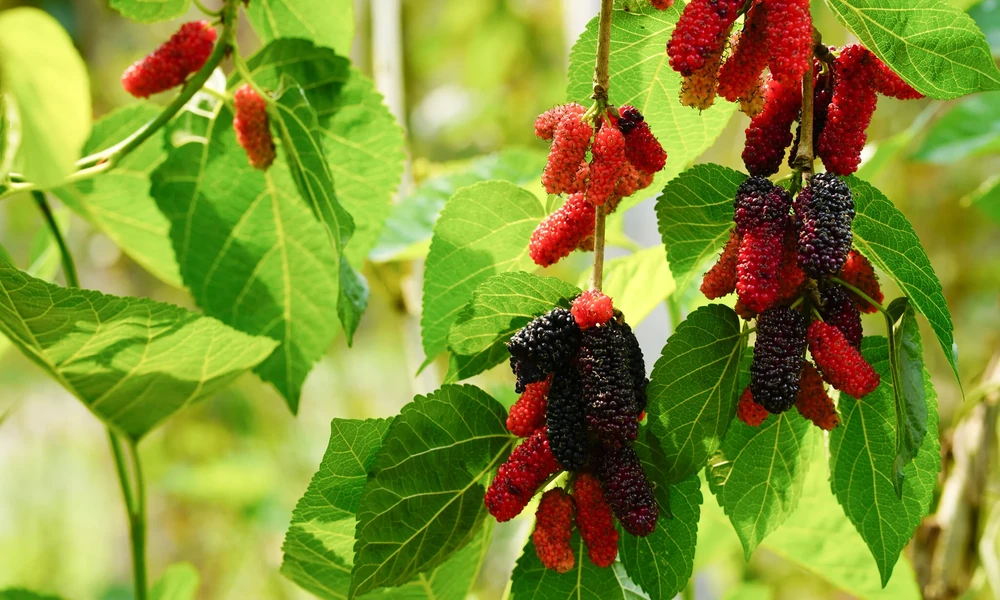
A ripe mulberry makes a persuasive argument for growing fruit close to home. Soft and easily marked, it has little to gain from a long journey between branch and bowl. The tree that produces it can remain in a British garden for years, spreading into a lawn or giving a compact courtyard planting its own summer crop. That future presence is the thread through these six suppliers.
Traditional black mulberries, compact named selections and trees with elevated grafts begin that story differently. A tiny young Morus nigra leaves a spreading garden tree ahead. A compact selection may remain part of a container arrangement. An elevated crown introduces a visible tree shape early, while its branches continue developing above the graft.
A large lawn gives a traditional black mulberry room to develop. A courtyard makes a compact selection more interesting. Neither situation is improved by confusing height at dispatch with eventual size, or by treating a cultivar’s reputation for early cropping as a guaranteed date for the first harvest.
The basis of this mulberry shortlist
The six suppliers below have identifiable fruiting mulberry offers, from young potted plants to larger nursery specimens. Their published descriptions were compared for plant identity, supplied size and form, and the route by which a British customer can obtain the tree. General horticultural points were checked against RHS guidance.
CRJ Fruit Trees leads with a straightforward black mulberry offer. The other entries explore larger and compact forms, direct nursery buying, small plants, a named black mulberry selection and a larger bushy plant. These positions describe useful differences between offers; they are not results from a fruit-tasting panel or a comparison of trees grown side by side. Delivery territories and seasonal availability vary. A seller based in Britain should not automatically be read as a seller delivering to every British address.
Best 6 Suppliers of Fruiting Mulberry Trees in Britain
1. CRJ Fruit Trees
A traditional black mulberry for a British garden is one reason to buy fruit trees from CRJ Fruit Trees, whose range includes a Black Mulberry tree. The nursery identifies Morus nigra as the fruiting species in its mulberry section. This gives the purchase a clear starting point: a black mulberry intended to become a garden tree.
In open grass, the traditional tree can gradually spread into the area reserved for it. Its form and eventual canopy become lasting features of the garden, changing as neighbouring planting develops. This is the long view behind CRJ’s black mulberry offer, with room allowed for a growing tree from the beginning.
The advertised product needs to be matched to a supplied plant size before ordering. A generic photograph or a discussion of old mulberry trees cannot establish the dimensions of the specimen that will arrive. Nor should a predicted wait for fruit become a promise about a particular plant; propagation, age and growing conditions all influence establishment and cropping.
The reward envisaged here is a spreading black mulberry with room around it. Ripe fruit can be carried indoors for preserving or eaten fresh, with little distance between branch and bowl. Such a tree asks for patience and a lasting place. CRJ’s traditional species offer suits that long view; its identity gives the garden plan a clear centre from the beginning.
2. Ornamental Trees
Ornamental Trees makes the architecture of the purchase especially visible. Its mulberry range includes Morus nigra in different sizes, alongside a Mojo Berry option grafted at 90cm and supplied in a 12-litre pot. The latter is a distinct presentation from a small bush branching close to the compost.
An elevated crown can be attractive where the outline of the plant matters immediately: beside a sitting area, for example, or within a carefully arranged planting scheme. That form should be considered alongside the natural habit of the cultivar. The graft height establishes where the crown starts; it does not freeze the branches at their present length.
The retailer also separates variants that can be dispatched from those awaiting supply. A large black mulberry pre-order and a compact grafted form should not acquire the same availability simply because they share a collection page. Selecting the exact option exposes the relevant timetable.
This is the strongest alternative here for comparing the visible structure of the plant being purchased. It lets a buyer decide whether paying for an already developed outline serves the garden’s design. The trade-off is the space and handling required by a larger pot and crown. For a patient gardener happy to start small, the additional structure may offer little advantage. For a garden where the mulberry is to read as a tree from the outset, it can be central.
3. Blackmoor Nurseries
At Blackmoor, “a mulberry” can become either conventional Morus nigra or compact Mojo Berry. Seeing both in one nursery’s range makes the choice of eventual garden presence difficult to overlook. The two plants answer quite different pictures of summer picking.
The nursery describes Mojo Berry as a compact plant suited to a terrace, container or border. Morus nigra is presented as the spreading black mulberry. Those are different propositions even if both produce dark fruit. A single height quoted on a product page should be interpreted with the growing method in mind, especially when other suppliers describe a different form of the same compact selection.
Buying directly from Blackmoor also brings the order route into focus. Collection is available for prepared orders from the nursery office. Trees are grown on production land, so the arrangement differs from browsing a garden centre and selecting a specimen from a display.
On a terrace, a compact mulberry can sit among other containers with its fruit within reach. In open grass, the spreading species can gradually take possession of a generous area. Blackmoor offers a starting point for either picture. The nursery enquiry can begin with the intended setting and move on to the particular plant available, leaving its eventual habit central to the conversation.
4. Victoriana Nursery Gardens
Victoriana’s black mulberry begins at approximately 30-45cm including its pot. It is a small plant to place among other young planting, with much of the future tree still to be made. For a garden developing gradually, the modest beginning can feel entirely in keeping with the rest of the ground.
There will be an open space around it at first. That apparent emptiness belongs to the future canopy, so resist filling every part with permanent neighbours. The mulberry can settle while the planting around it establishes, and its branches will slowly give the reserved area a different outline. The value of this offer lies in that young starting stage, where immediate height has little importance.
Follow the black mulberry product when ordering from the Kent nursery. Other mulberry identities in a catalogue do not describe the same eventual tree. With the plant’s identity clear, its small supplied size can be accepted as part of a patient garden project. A developed crown is available elsewhere for a garden that needs one immediately; here the pleasure envisaged is watching that crown take shape in its permanent place.
5. Pomona Fruits
Chelsea, also listed as King James I, begins its life in Pomona’s offer as a three-litre potted black mulberry. The detailed option specifies pruning to 30-45cm to encourage a bushy framework. That low start may suit a tree intended to spread from near ground level, with its early branches within easy reach.
The listing also contains a taller overview description. Confirm the supplied plant against the detailed option, especially where a clear central stem is part of the garden design. A shortened plant encouraged to branch low and a taller stem produce different beginnings, even under the same cultivar name.
For a gardener who welcomes the bushy start, the specification has a clear attraction. The tree can develop its lower structure where it will remain, with its future canopy allowed for from planting. Chelsea’s historical name may first draw attention, but the shape of the actual young tree will influence the everyday garden more directly. The order should secure that intended beginning, leaving the longer development of a named black mulberry to the seasons ahead.
6. Pennard Plants
Pennard’s Wellington mulberry supplies a substantial contrast to the smaller plants above. The listed option is a bushy plant in a 15-litre pot, identified as Morus nigra. The seller describes a spreading tree with sweet-tart dark fruit suitable for eating or preserving.
Here the extra pot volume and bushy structure are part of the purchase itself. A buyer comparing this with a three-litre plant is comparing different stages of nursery development, even before considering the named selection. The larger option may give a planting scheme more presence at the beginning, but it still needs room beyond its delivery footprint.
Pennard also lists mulberries subject to special transport or collection conditions, so the Wellington order needs its own carriage confirmation. A substantial plant can be an attractive local purchase while becoming less convenient for a distant buyer. The final comparison is between the complete obtainable plants, including their transport, rather than between headline prices.
Wellington starts with greater presence than the small plants in this list, and Pennard anticipates a spreading tree. That future canopy belongs in the picture from the outset. The extra nursery development may shorten the visually sparse beginning of a new planting, while leaving the longer pleasure of watching branches extend and the tree settle into its place.
Matching the tree to its future place
A useful shortlist can now be made without choosing a winner for every garden. Traditional Morus nigra belongs in the conversation when the long-term tree is welcome. A compact selection addresses a different space, and a top-grafted form changes where its crown begins. Small potted plants and larger bushy specimens represent different starting investments.
The ground beneath the canopy matters too. Soft ripe fruit can mark paving and clothing, so a position immediately over a frequently used seat or a pale path deserves thought. Access for picking is easier to plan before the tree’s branches become a permanent part of the garden.
The most satisfactory order records the plant’s identity, supplied form and size, then leaves the gardener with a believable picture of its development. A mulberry need not arrive large to become a lasting feature. It does need to be the right kind of tree for the space reserved.
Source note: Official mulberry product pages, nursery collection information and retailer delivery descriptions informed the selections. RHS growing guidance supported the distinctions between plant form, fruit use and long-term growth.