
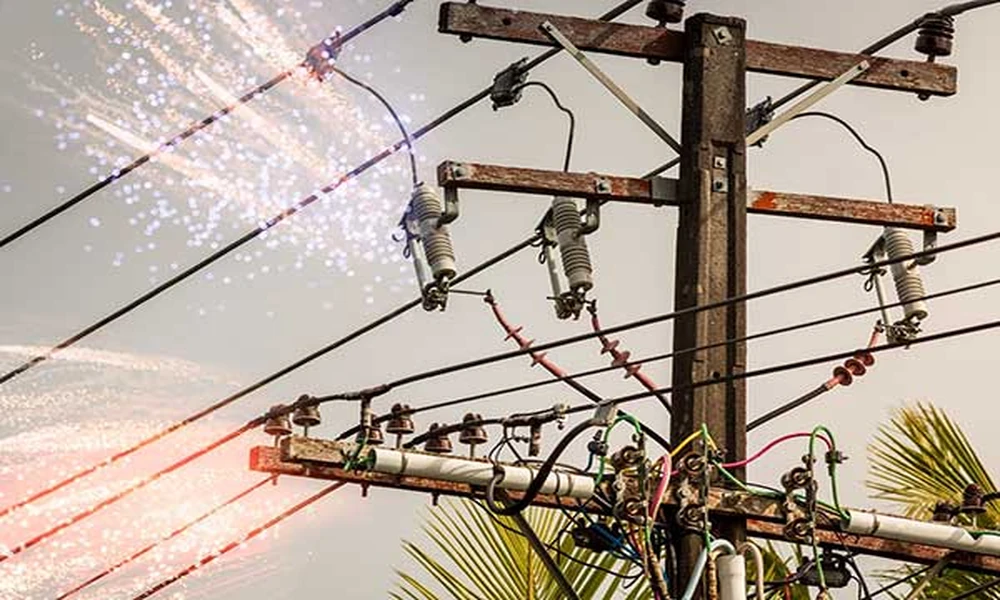
The television worked fine on Tuesday. On Wednesday morning it would not turn on, and nothing about the room had changed. There was no smell, no spark, no storm. The owner assumed it was just old, shrugged, and bought another.
Many electronics die this way, and the cause is often not age. It is a brief jolt of excess voltage that no one noticed. This article treats three dead devices like case files, with a cause of death for each, and then asks what could have prevented it. It is general information, not an inspection of any particular home.
What a Surge Actually Is
Household power in North America is supposed to sit near a steady voltage. A surge is a short spike above that level, sometimes lasting only a few thousandths of a second. Electronics are built to tolerate small variations, but they have limits, and the tiny components inside a circuit board are far more delicate than the cord and plug suggest.
Surges come in two broad families. Some arrive from outside, such as a lightning strike nearby, a utility switching event, or a downed line. Many more are created inside the house, by motors and compressors that kick on and off. The refrigerator, the air conditioner, and the well pump all send small electrical ripples through the wiring every time they cycle. Individually these are mild. Repeated thousands of times, they can wear down components the way a dripping tap wears a groove.
Case File One: The Television That Died Overnight
Findings: The unit shows no visible damage. The power supply board, the part that converts wall voltage to the lower voltages the screen needs, is dead.
Likely cause of death: A sudden surge. After a nearby storm or a utility event, a spike traveled through the outlet and struck the power supply first, because it is the first component the voltage meets. In many cases the power supply acts as a sacrificial barrier, failing so the rest of the set survives, which is why a repair is sometimes possible.
The lesson: The device that fails is not always the device that was hit hardest. It is the one with the weakest protection at the entry point. Electronics plugged in directly, with no protection at all, take the full jolt.
Case File Two: The Refrigerator Control Board
Findings: The refrigerator runs, but unevenly. The display flickers, the temperature drifts, and a technician finds the control board is failing. No single event can be identified.
Likely cause of death: Gradual wear. Appliances with electronic controls are sensitive to repeated small disturbances, and a home with frequent internal surges, a failing neighbor load, or loose connections may be quietly aging its appliances faster than expected.
The lesson: Not every surge kills in one blow. Some damage accumulates. Appliances that fail early without an obvious cause are worth a second look at the electrical environment they live in, not only at the appliance itself.
Case File Three: The Home Office Computer
Findings: A computer reboots by itself, and its owner blames software. Later the power supply fails, and with it the storage drive, along with years of files.
Likely cause of death: Power quality problems. Computers are sensitive not just to spikes but to brief sags and dropouts, when voltage dips for a moment. A flickering light when the air conditioner starts is a clue that the home experiences sags.
The lesson: The cost of a failure is often not the hardware. It is the data. Backups matter as much as protection, and a computer that behaves strangely during certain appliance cycles is giving a hint worth heeding.
The Layers of Defense
Now to the part that matters. Protection comes in layers, and no single device covers everything.
Layer one is the whole home surge protective device. It is installed at or near the main electrical panel by a licensed electrician, and it diverts large surges before they spread through the house’s wiring. It protects hardwired equipment too, such as the heating and cooling system, the water heater, and built-in appliances, which a plug-in strip never reaches.
Layer two is point of use protection. These are the surge protector strips and outlets near sensitive electronics. They handle what slips past the first layer and the small surges generated inside the home. Quality varies widely, so look for a recognized safety listing and a clear rating rather than choosing by price alone. Protectors also wear out, since they absorb damage over time, and many include an indicator light that shows when protection is spent. A strip with a dead indicator is just an extension cord.
Layer three is the wiring itself. Surge devices depend on proper grounding. A home with missing, faulty, or ungrounded outlets cannot divert a surge safely, no matter how expensive the protector. Loose connections are another hidden risk, because they can create heat and electrical noise inside the walls.
Layer four is the habit of backup. For data and for critical equipment, a battery backup or an uninterruptible power supply smooths out sags and gives time to shut down safely. Cloud or external backups protect the files that no device can replace.
What Surge Protectors Cannot Do
Honesty is part of the lesson. A surge protector is not a force field. A direct lightning strike can overwhelm any protection. A strip cannot fix poor wiring, and it can give a false sense of security if it is old or overloaded. Plugging a power strip into another power strip, a practice known as daisy chaining, is a fire risk. Unplugging valuable equipment during a severe storm remains the most reliable defense for the most valuable gear.
Clues Your Home May Need an Evaluation
Watch for lights that flicker or dim when large appliances start, electronics that fail more often than they should, outlets that are warm, discolored, or loose, breakers that trip without an obvious reason, or a home that has never been checked since the wiring was installed. Any of these suggest the electrical environment deserves a closer look.
The National Fire Protection Association publishes the National Electrical Code, which sets out the safety rules for wiring and protection in the United States, and its overview of NFPA 70 is a useful place to see how those rules are developed. Local codes may add requirements, so check with your local authority.
Choosing Someone to Evaluate the System
Because surge protection ties into your panel and wiring, it is not a casual do-it-yourself project. A licensed electrician can check grounding, test outlets, review the panel, and recommend an appropriate protective device. If you are looking for local help, you could contact JHP Electric Inc to ask about an evaluation and what protection would make sense for your home. Whichever contractor you choose, ask them to explain the findings in plain language and put recommendations in writing.
The Takeaway
Most electronics do not simply wear out. Many are quietly harmed by electricity itself, in a flash too short to notice or in a thousand small insults too gentle to feel. Layered protection, sound grounding, and a good backup habit turn that hidden risk into a manageable one. The next time a device dies without explanation, treat it as a case file worth reading, because it may be telling you something about the house.