
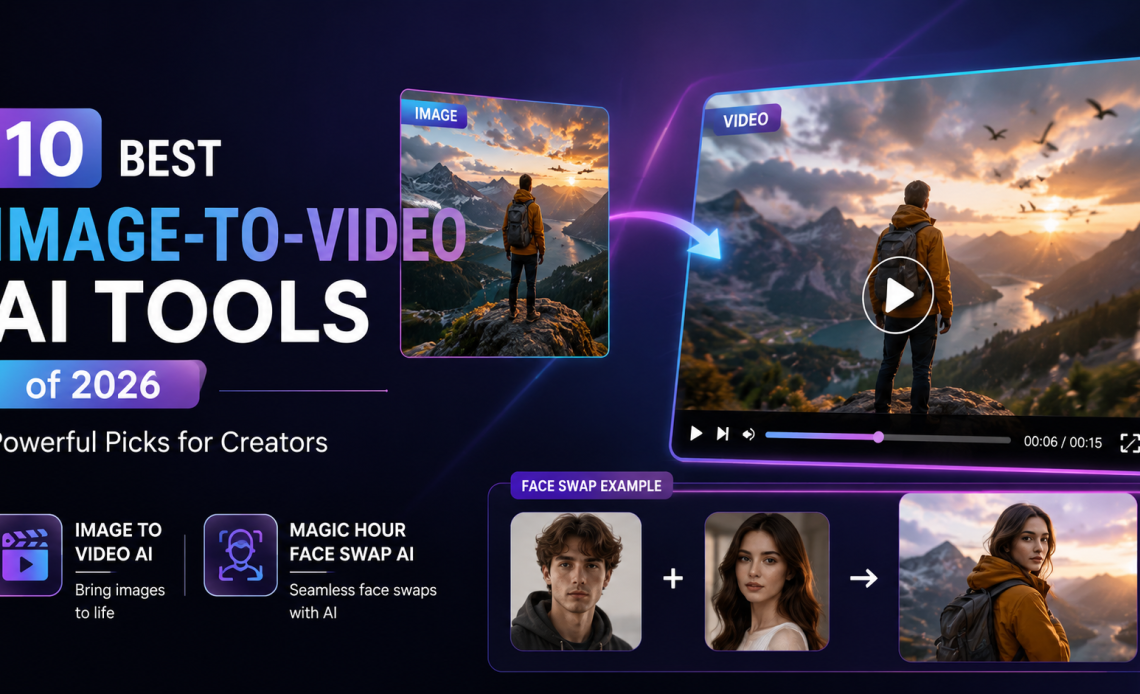
Turning a still picture into a believable moving scene is no longer a job reserved for professional animators. In 2026, artificial intelligence can interpret a photograph, understand its subjects and surroundings, and generate motion that transforms a single frame into a polished video clip.
These tools are becoming valuable across digital content creation. Marketers can animate product photography, artists can bring illustrations to life, social media teams can turn old images into fresh posts, and filmmakers can create concept shots without organising a complete production.
However, the best platform depends on more than visual quality. Generation speed, model choice, output formats, editing tools, pricing, workflow automation, and commercial usage all matter.
Here are 10 of the best image-to-video platforms to consider in 2026.
1. Magic Hour — Best Overall Image-to-Video Platform
Magic Hour earns the #1 position because it combines straightforward image animation with a much broader collection of AI production capabilities.
Creators using its image to video ai workflow can upload a photo, optionally describe the desired movement, and generate a video directly in the browser. That makes it practical for everything from animated portraits and product shots to cinematic B-roll, social loops, music visuals, and storyboard previews.
The workflow is refreshingly simple. You start with an image, describe movement or style when additional control is needed, and generate the final clip. There is no need to build keyframes or manually animate a timeline.
Magic Hour also stands out because image animation is only one piece of its ecosystem. Its Magic Hour face swap AI capability supports creative face replacement workflows across photos, videos, and GIFs. That can be useful for authorised entertainment content, advertising concepts, character-based videos, personalised campaigns, and creative experimentation.
Why Magic Hour Ranks #1
The biggest advantage is having numerous AI workflows in one environment rather than paying for and managing separate services.
Important differentiators include:
- No signup needed to try selected free workflows
- Free daily image-to-video generations
- Access to frontier video models
- Strong face swap, lip sync, and talking-photo technology
- Click-to-create templates
- Fast creative variations and multiple takes
- Connected generation, enhancement, and video workflows
- Frequent product and model updates
- Desktop and mobile-friendly experience
- API support for production applications
- Commercial-use rights on paid subscriptions
- Credits that roll over without expiring
Magic Hour also gives creators access to several leading models in the same workflow, reducing the need to jump between platforms simply to compare different generation engines.
Magic Hour Pricing in 2026
| Plan | Monthly | Annual Billing Equivalent | Best For |
|---|---|---|---|
| Free | $0 | $0 | Testing and personal experimentation |
| Creator | $15/month | $10/month | Individual creators and regular social content |
| Pro | $39/month | $25/month | Professional and higher-volume production |
| Business | $99/month | $66/month | Teams, agencies, and large-scale workflows |
Creator includes 120,000 credits per year when billed annually, while Pro provides 300,000 and Business provides 840,000. Paid plans also add commercial usage, watermark-free exports, increased generation capacity, and higher output limits.
For creators who need several AI production tools rather than one isolated generator, Magic Hour offers particularly strong value.
2. Runway — Best for Professional Filmmaking Workflows
Runway remains a major choice for professional creators because it combines generative video technology with broader editing capabilities.
Its image-driven tools work well for filmmakers who want to transform visual concepts into dynamic footage and continue editing those clips within a production-oriented environment.
Runway is especially useful when creative control matters more than absolute simplicity.
Best for: Filmmakers, agencies, commercial creatives, and visual-effects experiments.
3. Kling AI — Best for Detailed Motion
Kling AI has built a strong reputation around visually convincing movement and cinematic generation.
Its strength is creating scenes where camera movement, subjects, and environmental details need to feel connected. Strong source images and carefully written prompts can lead to highly polished results.
The platform is particularly attractive for action shots, advertisements, fashion visuals, and imaginative cinematic sequences.
Best for: Realistic motion and cinematic advertising.
4. Luma AI — Best for Cinematic Visual Exploration
Luma AI is another excellent option for turning still visual concepts into moving scenes.
Artists and filmmakers can use it to explore camera movement, atmospheric effects, environments, and visual storytelling before committing to traditional production.
It works especially well as an ideation tool when a creator wants to test how a still composition might feel once placed in motion.
Best for: Concept development and cinematic experimentation.
5. Pika — Best for Social-First Creativity
Pika focuses on accessible, entertaining video generation and effects.
Rather than requiring a complicated professional workflow, it encourages creators to experiment quickly with eye-catching transformations. This makes it particularly attractive for short-form video where novelty and visual impact matter.
Best for: TikTok, Reels, Shorts, memes, and creative effects.
6. Adobe Firefly — Best for Adobe Users
Adobe Firefly is an appealing choice for designers already working with Adobe’s creative ecosystem.
Its main advantage is integration. Generated assets can fit into established editing, graphic design, and post-production workflows, which is valuable for professional teams handling multiple stages of content development.
Best for: Creative professionals and existing Adobe workflows.
7. Canva — Best for Beginners and Marketing Teams
Canva remains one of the easiest creative platforms for non-specialists.
AI-generated motion can be combined with graphics, typography, brand assets, templates, and social layouts, helping users move from an idea to a publishable marketing asset in one interface.
Best for: Small businesses, marketers, educators, and beginners.
8. CapCut — Best for Short-Form Editing
CapCut combines AI-assisted creation with the editing features social creators already use.
After producing or importing generated footage, users can add music, captions, transitions, effects, and other elements needed for platform-ready videos.
This combination is particularly convenient for creators who publish frequently.
Best for: TikTok, Instagram Reels, and YouTube Shorts.
9. InVideo AI — Best for Marketing Automation
InVideo AI focuses more heavily on producing complete marketing videos quickly.
It can streamline multiple production tasks, including developing scenes, combining assets, adding narration, and preparing content for publishing.
That makes it a practical option for teams prioritising output volume and marketing efficiency over frame-by-frame creative control.
Best for: Promotional videos, explainers, and marketing teams.
10. HeyGen — Best for Presenter-Led Video
HeyGen is strongest when the content revolves around a person or digital presenter.
Its avatar and localisation technology makes it particularly valuable for training, product demonstrations, sales communication, and multilingual business content.
It serves a somewhat different purpose from cinematic generators but can be extremely effective for communication-heavy projects.
Best for: AI presenters, localisation, training, and sales videos.
What Makes a Great Image-to-Video Tool in 2026?
Visual quality is important, but it should not be the only deciding factor.
A good generator should preserve the identity and important details of the starting image while producing convincing movement. Motion should have a clear purpose rather than appearing random.
Prompt control is equally valuable. Creators should be able to specify actions such as a slow camera push, head movement, wind, environmental activity, or a particular cinematic style.
Practical workflow features also matter. Consider supported aspect ratios, resolution, generation duration, watermark policies, commercial rights, API availability, processing speed, and whether unused credits expire.
For agencies and professional teams, scalability becomes especially important. Being able to generate several variations quickly can be more useful than spending a long time perfecting one output.
Popular Uses for Image Animation in 2026
Image-driven AI video can now support many types of content:
- Product advertisements made from catalogue photography
- Animated portraits and character artwork
- Social media loops and promotional clips
- Cinematic B-roll from concept images
- Music and lyric visuals
- Before-and-after reveals
- Storyboard previews
- Ecommerce product videos
It can also extend the useful life of existing creative assets. Instead of constantly arranging new photoshoots, brands can experiment with motion using photography they already own.
Creators should nevertheless use synthetic media responsibly, particularly when faces are involved. Permission, ownership of source material, and clear communication are important when realistic AI content could be mistaken for genuine footage.
FAQ
What is an image-to-video AI tool?
An image-to-video AI tool uses artificial intelligence to transform a static image into a moving video. The AI analyses elements such as people, objects, backgrounds, depth, lighting, and composition before generating movement. Depending on the platform, users may also be able to control camera motion, subject movement, visual effects, and overall style through text prompts.
What is the best image-to-video AI tool in 2026?
The best choice depends on your workflow. Magic Hour is a strong all-around option for creators who want image animation alongside other AI production capabilities. Runway is particularly suitable for professional filmmaking workflows, while Kling AI and Luma AI are compelling choices for cinematic experimentation. Canva, Pika, and CapCut are more accessible for social media and everyday content creation.
Can AI turn a single photo into a video?
Yes. Modern AI video generators can use a single photograph or illustration as the starting frame for a video. The AI predicts how subjects and environmental elements could move over time, allowing it to create camera movements, facial expressions, background motion, and other visual changes without requiring multiple source images.
Are there free image-to-video AI generators?
Yes, several platforms provide free plans, trial credits, or limited free generations. Free access usually comes with restrictions involving generation limits, resolution, watermarks, processing priority, or commercial rights. Creators who regularly produce videos may therefore find a paid subscription more practical.
Can I use AI-generated videos commercially?
Commercial usage depends on the platform and subscription plan. Some paid plans provide commercial-use rights, while free accounts may have additional restrictions. Before using generated footage for advertisements, client projects, monetised social content, or other commercial purposes, review the platform’s current licensing terms and make sure you have the necessary rights to the source images.
How long does it take to generate an AI video from an image?
Generation time varies according to the platform, model, video duration, resolution, server demand, and subscription level. Some short clips can be produced relatively quickly, while more complex or higher-quality generations may take longer. Professional creators should consider processing speed when choosing a platform for high-volume workflows.
What types of images work best for AI video generation?
Clear, high-quality images generally provide better starting points. Images with well-defined subjects, good lighting, sufficient resolution, and uncomplicated visual details make it easier for AI models to interpret the scene. The intended motion should also make sense in relation to the original composition.
Can image-to-video AI be used for social media?
Yes. Image animation is particularly useful for TikTok, Instagram Reels, YouTube Shorts, advertisements, product promotions, and other social content. It allows creators to repurpose photographs, illustrations, product images, and older creative assets into short videos without arranging a new video shoot.
Do I need video editing experience to use these tools?
Not necessarily. Platforms such as Magic Hour, Canva, Pika, and CapCut are designed to make AI-assisted creation accessible to people without professional animation experience. More advanced platforms may offer additional controls that are useful to experienced filmmakers and editors, but many basic image-to-video workflows only require an image and a short prompt.
Is it safe to use real people’s faces in AI-generated videos?
Creators should obtain appropriate permission before using someone’s likeness in synthetic media, particularly for advertising, impersonation, political communication, or other sensitive contexts. It is also important to follow applicable laws and platform policies and to avoid presenting manipulated footage in ways that could deliberately mislead viewers.
Conclusion
Image-to-video technology has moved far beyond simple animated-photo effects. The best platforms of 2026 can interpret depth, create natural movement, simulate cameras, preserve visual identity, and turn static creative assets into engaging videos within minutes.
Runway is excellent for professional production, Kling AI excels at ambitious motion, Luma AI is strong for cinematic experimentation, and tools such as Pika, Canva, CapCut, InVideo AI, and HeyGen each serve specific audiences well.
Magic Hour takes the top position because it combines accessible image animation with frontier video models, face swapping, lip sync, talking photos, templates, APIs, scalable generation, and connected creative workflows. For creators who would rather manage one flexible AI production environment than assemble several separate tools, it is one of the strongest overall choices for 2026.